Backflow Testing in Ontario: How Often, Who Must Comply, and What a Failed Test Means
Who must test backflow preventers in Ontario, how often, who can do the test, and what happens after a failed test. A guide for property managers.


If you manage commercial or multi-unit buildings in Ontario, backflow testing is one of the few plumbing jobs with a legal deadline attached. Miss it and the municipality sends a notice. Ignore the notice and the next step can be a fine or, in some programs, a shut-off of the water service. The good news is that it is also one of the easiest compliance items to keep on schedule once you know what you have, where it is and when it is due.
This guide is written for property managers, condo boards and facility operators who look after one building or several across Southwestern Ontario and the Greater Toronto Area. It covers what backflow testing is, which properties must comply, how often the test happens, who is allowed to do it, what happens when a device fails, and how to run testing across a portfolio without chasing a different deadline at every address.
What is backflow testing?
Backflow is water flowing the wrong way through a plumbing system. It happens in two ways. Back-siphonage occurs when pressure drops in the municipal main, for example during a watermain break or heavy firefighting draw, and water is pulled backward out of the building. Back-pressure occurs when pressure on the building side rises above the supply pressure, for example from a boiler, a booster pump or a fire sprinkler system.
Either way, water that has sat in a boiler loop, a chemical feed, an irrigation line, a fire line or a process tank can end up in the public drinking water supply. That is called a cross connection, and municipal backflow programs exist to control it.
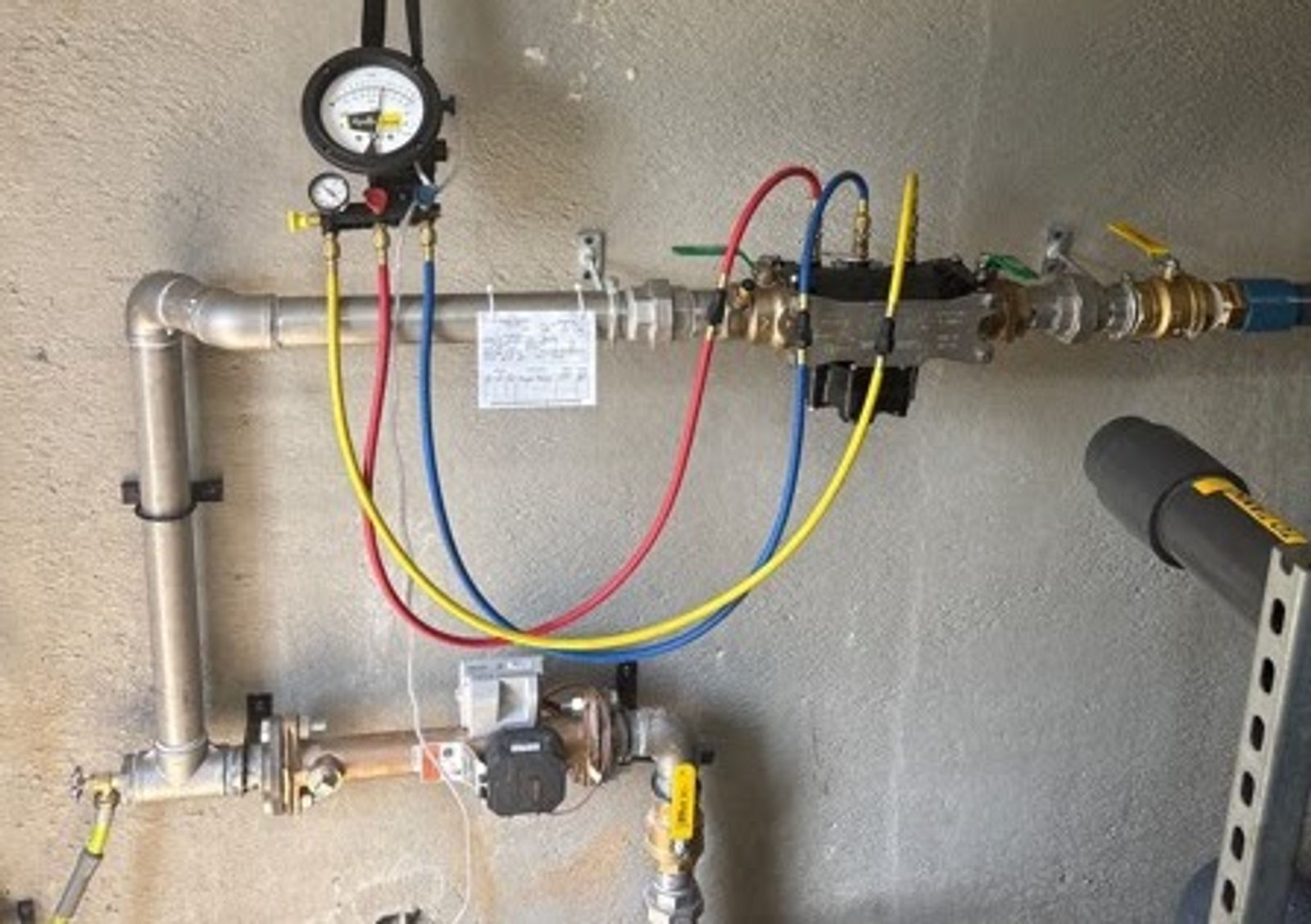
A backflow preventer is a mechanical assembly of check valves, and on higher hazard devices a relief valve, that stops reversed flow. Like any mechanical valve it wears. Springs weaken, rubber seats harden and debris lodges in the valve. Backflow testing is the field test that proves each valve still seals under pressure. A certified tester connects a calibrated differential pressure gauge to the device's test cocks, isolates it, and measures whether each check valve holds and whether the relief valve opens at the right point.
Is backflow testing mandatory in Ontario?
For most commercial, industrial, institutional and multi-residential properties, yes. The requirement comes from two layers.
The Ontario Building Code sets the installation rule. Article 7.6.2.6 requires premise isolation, meaning a backflow preventer at the building's water service, wherever backflow could cause a moderate or severe hazard. The device must be selected under CSA B64.10, the national standard for selecting and installing backflow preventers. Its companion standard, CSA B64.10.1, covers maintenance and field testing (Standards Council of Canada).
Municipal by-laws set the testing and reporting rules. The province does not set one testing schedule. Each water utility runs its own cross connection control or backflow prevention program, and the by-law that applies to your property is the one for the system that supplies its water. The Province publishes guidance for municipalities setting up these programs (Government of Ontario).
Programs are in place across the markets most property managers in this region deal with:
City of Toronto. Under the Water Supply By-law (Municipal Code Chapter 851, Schedule 6), industrial, commercial, institutional and multi-residential properties must have a premise isolation device at each water service connection. Owners also file a cross connection survey and update it at least every five years, or within 30 days of any increase in hazard level (City of Toronto).
City of Hamilton. Backflow Prevention By-law 10-103 applies to industrial, commercial, institutional and multi-residential properties, with the program page setting the multi-residential line at buildings four storeys or higher. The City's test report form requires the original report within 14 days of the test, mailed or hand delivered (City of Hamilton).
City of Guelph. Every property owner with a backflow device must have it tested by a qualified person when it is installed and every year after, with the report sent to the Building Services Backflow Coordinator within 14 days of the test (City of Guelph).
Kitchener, Waterloo and Cambridge. Each city runs its own program. Kitchener's by-law covers commercial, industrial, institutional, large multi-residential buildings and irrigation systems (City of Kitchener). Waterloo publishes its own by-law and test report form (City of Waterloo), and Cambridge takes reports through its online application portal (City of Cambridge).
London and Halton Region also run backflow prevention programs, as listed by the City of Ottawa's program page (City of Ottawa).
The practical rule: the notice from your water utility and the by-law it cites are the documents that govern your building. If you manage properties in more than one municipality, you are working to more than one by-law.

Who must test, how often, and which device
The table below summarizes the common pattern across Ontario programs. Your municipality's by-law has the final word on thresholds and deadlines.
Property type | Typical hazard level | Typical device | Test frequency |
|---|---|---|---|
Restaurants, labs, medical and dental offices, car washes, manufacturing, buildings with chemically treated boilers | Severe | Reduced pressure principle assembly (RP or RPZ) | On installation, after repair or relocation, and every year |
Offices, retail, plazas, schools, most multi-residential and condo buildings | Moderate | Double check valve assembly (DCVA) | On installation, after repair or relocation, and every year |
Fire sprinkler services | Moderate to severe, depending on additives and connections | DCVA or RP on the fire line | Annually under the backflow by-law, alongside fire protection inspections |
Lawn and landscape irrigation | Moderate to severe, depending on fertilizer injection | Pressure vacuum breaker (PVB), DCVA or RP | On installation and annually; some programs cover irrigation separately |
Buildings with no direct auxiliary supply connection | Minor | Dual check valve (not field testable) | Replaced, not tested |
Two points are worth knowing. First, a building often has more than one device: one at the water service for premise isolation, one on the fire line, and others on individual pieces of equipment inside (zone or point-of-use protection). Every testable device gets tested. Second, a change of tenant can change the hazard level. A retail unit that becomes a restaurant or a dental office may need a higher class of device, which is why Toronto requires the survey to be updated within 30 days of a hazard increase.
Who can perform a backflow test?
Not every plumber can sign a backflow test report. Ontario programs require a tester who has completed a cross connection control course in backflow preventer testing from an accredited organization and holds a current certificate. Guelph's by-law names the Ontario Water Works Association as one such body, and the Region of Waterloo's by-law sets the same course requirement (City of Guelph by-law). Toronto refers to these testers as certified Cross Connection Control Specialists. Many municipalities also require the tester or their company to register with the program, and Hamilton requires an annual calibration certificate for every test kit used.
Repairs and replacements are a separate line. London's program, for example, requires that installation, replacement or repair of a testable device be done by a plumber licensed in Ontario.
When you hire a tester, ask three things: is the tester certified and registered with your municipality, is the gauge calibration current, and will they complete and submit the report in the format your water utility requires.
How a backflow test works on site
A routine annual test follows the same steps on every device:
Isolate the device. The tester closes the shut-off valves on either side. Water to that service is interrupted for the length of the test, so book it around tenants, kitchens and any process that depends on water.
Connect the gauge. Hoses from a calibrated differential pressure gauge go onto the device's test cocks.
Test each valve. On a DCVA, each check valve is tested for a tight seal. On an RP, the tester also checks the pressure at which the relief valve opens.
Record and tag. Results are recorded on the municipal form, the device is tagged with the test date, and water is restored.
File the report. The report goes to the water utility by the method and deadline in your by-law. Guelph and Hamilton, for example, both set 14 days.
Buildings with a single water service sometimes have no bypass. If the test means a full building shut-off, plan it as a scheduled outage and notify tenants in advance.
What happens when a backflow preventer fails the test?
Backflow preventers do fail, usually because of wear rather than damage. Common causes are a fouled or worn check valve seat, a weak spring, debris from the water main, or a relief valve that discharges early on an RP device.
A failed test does not automatically mean a new device. The usual sequence is:

Written result. The tester records the failure on the report and explains which valve failed.
Repair or rebuild. Most failures are fixed with a repair kit: new rubber parts, springs or a cleaned seat. The device is then retested.
Replace when needed. A cracked body, a device that is no longer approved, or a device that is the wrong class for the building's hazard needs replacing. In Toronto, a replacement needs a building permit.
Report the outcome. The municipality expects the failed device to be repaired or replaced and a passing test filed within the window set by its by-law.
Leaving a failed device in service is the outcome to avoid. The building is unprotected, and the municipality knows, because it receives the report.
Running backflow testing across a portfolio
For a property manager with ten buildings in three cities, the hard part of backflow compliance is not the test. It is the calendar. Every device has its own due date, every municipality has its own form and deadline, and a single missed notice can turn into a compliance letter.
A few habits make it routine:

Build a device register. One line per device: building, location in the building, device type and size, serial number, municipality, last test date and next due date. If you do not know what is in a building, start with a survey.
Align the dates. Where the by-law allows it, test every device in a building on the same visit, and group buildings by municipality so one tester visit covers several sites.
Use one tester for the portfolio. One certified team, one report format, one invoice and one record of every device is easier to defend in an audit than a folder of reports from five companies.
Fold it into maintenance. Annual backflow testing fits naturally on the same schedule as drain cleaning, sump pump service and water heater checks. Our commercial plumbing maintenance checklist puts it on the annual list alongside the other Ontario compliance items.
Watch for tenant changes. A new restaurant, clinic or salon tenant is the most common trigger for a higher hazard class and a new device.
Backflow testing with Elevate Plumbing
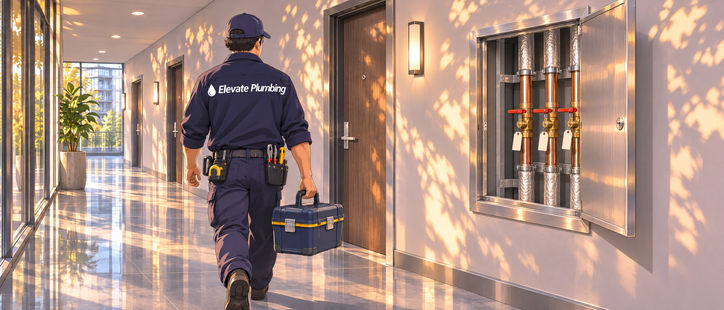
Elevate Plumbing, a division of Elevate Service Group, provides certified backflow testing, repair and new device installation for commercial, industrial, institutional and multi-unit properties. Our certified testers test every device on site with a calibrated gauge, tag it, and complete the test report in the format your municipality requires, with a copy kept for your records. Failed devices get a repair quote on the spot, and we can rebuild or replace and retest the same device.
The crew is based in New Hamburg and serves Kitchener-Waterloo, Cambridge, Guelph, London, Hamilton, Toronto and the rest of Southwestern Ontario and the GTA. For property managers, annual testing can sit inside a plumbing maintenance contract with our commercial plumbing team, so next year's test is booked before it is due. Behind the local crew is Elevate Service Group, with more than 130 technicians across plumbing, electrical and facility services, which is what lets one contract cover multiple sites and multiple trades. If a backflow problem turns into a water emergency, our 24/7 emergency plumbing service is there around the clock.
To book testing, send us your device list or your municipality's notice through the contact page and we will quote per device or per property.
Frequently asked questions
How often is backflow testing required in Ontario?
Testable backflow preventers on commercial, industrial, institutional and multi-residential properties are tested when installed, after any repair or relocation, and every year after that. The province does not set the schedule. Your municipality's backflow or cross connection control by-law does, and the notice from your water utility will name the due date.
Is backflow testing mandatory in Ontario?
Yes, for properties covered by a municipal backflow prevention program, which in most Ontario cities means ICI and multi-residential buildings. The Ontario Building Code requires the device where backflow could cause a moderate or severe hazard, and the municipal by-law requires the annual test and report. Missing a test can lead to a compliance notice, fines and, in some programs, a water shut-off.
Who can perform backflow testing?
A tester who has completed an accredited cross connection control course in backflow preventer testing, such as the Ontario Water Works Association course, and holds a current certificate. Many municipalities also require the tester to register with the program and use a gauge with a current calibration certificate. Repairs and replacements are done by a licensed plumber.
How long does a backflow test take?
A routine test on an accessible device is a short visit, but the water to that service is shut off while the device is isolated. The total time depends on how many devices the building has, how easy they are to reach, and whether any fail and need repair. Ask for a site visit estimate if you have several devices or no bypass.
How much does a backflow test cost?
Pricing depends on the number of devices, their size and type, how accessible they are, and whether the property can be tested on one visit. Multi-site portfolios can usually be quoted per device on an annual schedule. Elevate Plumbing quotes per device or per property, with the municipal report included.
What happens if a backflow preventer fails the test?
The tester records the failure, explains which valve failed and quotes the repair. Most failures are fixed with a repair kit and a retest. A damaged, unapproved or wrong-class device is replaced, which in some municipalities needs a building permit. The municipality expects a passing test on file within the window in its by-law.
Is a backflow preventer the same as a backwater valve?
No. A backflow preventer sits on the water supply and protects drinking water from contamination. A backwater valve sits on the sewer line and stops sewage from backing up into the building during a municipal sewer surcharge. Many buildings need both, and they are maintained on different schedules. For basement flooding protection, see our sump pump installation and service page.
Tags:
Author

Elevate Plumbing Team
Elevate Plumbing is a division of Elevate Service Group.
Leave a comment
This will be publicly visible.
Your email address will not be published.
Your comment will be reviewed by an admin before it is published.